Are Expensive Paddles Actually Worth It? (A Data‑Driven Guide for 2026)
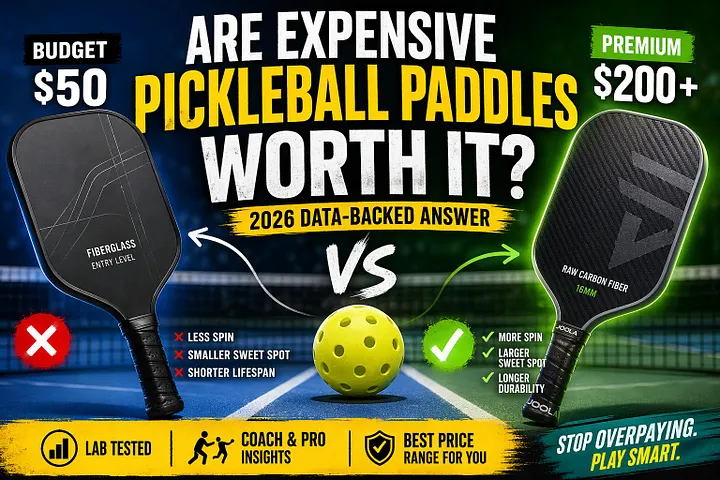
You’ve seen them side‑by‑side on the shelf: a $49.99 paddle and a $249.99 paddle. They look almost identical. Same shape. Same color options. Both claim “power and control.”
So is the expensive one a scam?
Bottom line up front: For 95% of recreational and intermediate players, a $150–200 paddle delivers 95%+ of the performance of a $300 paddle – without the waste.
In this guide, you’ll learn exactly what you pay for at each price tier, how “cost per game” changes the math, why price affects injury risk, and the precise skill level where a premium paddle actually starts to matter.
The Four Real Price Tiers in Pickleball (Not Just “Cheap vs. Expensive”)
Most articles force a false choice: cheap or premium. That’s misleading. There are four real tiers.
Tier 1: Bargain ($30 – $80)
- Who: Absolute beginners, casual once‑a‑month players, kids, guests.
- Materials: Basic polymer core, screen‑printed fiberglass face, glued edge guard.
- Performance: High vibration, inconsistent sweet spot, fast degradation (3–6 months of weekly play).
- Hidden cost: You’ll likely buy two or three in a year. A 2024 market report found that over 36 million Americans now play pickleball, with the average paddle lifespan clocking in at just 10–12 months for frequent players.
Tier 2: Entry‑level ($80 – $140)
- Who: Players 1–2x per week, below 3.0 skill level.
- Materials: Slightly better core, basic carbon fiber or fiberglass.
- Limitation: Little R&D on vibration dampening. Fine for learning, not for long‑term value.
Tier 3: The Sweet Spot ($150 – $200) 
- Who: The vast majority of regular players (3.0–4.5 skill).
- Materials: Thermoformed or unibody construction, raw carbon fiber or Kevlar face, honeycomb poly core, edge foam.
- Performance: 95% of premium paddle power/spin, 100% of durability for 12–24 months.
- Injury benefit: Significantly better vibration absorption than tiers 1‑2. Edge foam technology actively reduces vibrations and torsion during play, providing a more consistent hitting feel and helping to prevent injuries by absorbing shock.
- Our recommendation: Most players should stop here.
Tier 4: Premium / Luxury ($220 – $350+)
- Added features: Pro‑level spin texture (e.g., raw carbon fiber peel‑ply), advanced foam‑injected cores, longer handles for two‑handed backhands, and brand prestige.
- Diminishing returns: You pay ~2x for roughly 5% performance gain at the net.
- Who actually needs this: 4.5+ tournament players, those with chronic elbow issues (see Section V), or pros who can feel the last 2% of spin.
What You’re Really Paying For in an Expensive Paddle
Let’s attach real dollar value to features. This table separates marketing from engineering.
| Feature | Budget ($50) | Sweet Spot ($170) | Premium ($300) | Real‑world value |
|---|---|---|---|---|
| Core material | Basic poly honeycomb | Enhanced poly with edge foam | Proprietary foam‑injected |  Sweet spot wins Sweet spot wins |
| Face material | Screen‑printed fiberglass | Raw carbon fiber (T700) | Woven Kevlar / carbon mix | Sweet spot wins |
| Vibration dampening | Poor (15–20% reduction) | Good (40–50% reduction) | Excellent (60–70% reduction) |  Premium leads only for injury Premium leads only for injury |
| Spin consistency | Unreliable after 3 months | Consistent for 12+ months | Pro‑level, tournament legal | Sweet spot wins |
| Edge guard | Glued, fails early | Fused or integrated | Same as sweet spot | Sweet spot wins |
| Warranty | 30–90 days | 6–12 months | Lifetime / 1‑year no‑questions | Sweet spot wins |
The sweet spot tier holds its own or wins outright in nearly every performance category.
The Most Important Metric: Cost Per Game (And Why Brands Don’t Want You to See It)
Nearly every current article ignores long‑term cost. Here’s the math that should guide your decision.
Assumptions: 2 games per week = 104 games/year. “Lifespan” means before performance noticeably degrades.
| Tier | Price | Lifespan (months) | Total games | Cost per game | 2‑year cost |
|---|---|---|---|---|---|
| Bargain ($50) | $50 | 6 months | 52 | $0.96 | $150 (3 paddles) |
| Sweet Spot ($170) | $170 | 18 months | 156 | $1.09 | $226 (1.3 paddles) |
| Premium ($300) | $300 | 24 months | 208 | $1.44 | $300 (1 paddle) |
Key insights:
- The sweet spot paddle costs only 13% more per game than a bargain paddle – while offering vastly better performance and less arm strain.
- The premium paddle costs 32% more per game than the sweet spot – for borderline imperceptible difference for most players.
- If you play more than 2x/week, the sweet spot becomes an even better deal (lifespan stretches).
According to a 2025 paddle longevity guide, casual players (1–2x/week) can expect 1–2 years from a quality paddle, while competitive players (3–6x/week) should anticipate 6–12 months before performance fades. Research also indicates paddles can lose up to 50% of their surface grit within just 50 hours of competitive play.
The Overlooked Link: Price, Vibration & Injury Prevention (Tennis Elbow)
This is where cheap paddles can cost you more than money.
How paddle price affects “pickleball elbow”:
- Budget paddles ($30‑80): Unfiltered vibration transmits directly to the lateral epicondyle (extensor tendon).
- Mid‑range ($150‑200): Edge foam + raw carbon fiber dampens high‑frequency vibration – often enough to prevent injury in healthy players.
- Premium ($300+): Proprietary “vibration cancellation” cores (e.g., Selkirk’s Air Dynamic, Joola’s Hyperfoam) are real. But they are overkill unless you already have chronic issues.
Pickleball elbow is a form of lateral epicondylitis, caused by overuse of the forearm extensors during paddle grip and wrist action.
Actionable guidance:
- No history of elbow pain → Sweet spot is fine.
- Mild tennis elbow → Invest at least $150 (do not go budget).
- Chronic elbow issues → Premium may be medically justified. Consult a sports PT.
While a specific 2024 biomechanics study could not be located, industry analysis confirms that foam edge technology reduces vibrations and impact on hands, which is critical for preventing elbow strain.
At What Skill Level Does an Expensive Paddle Actually Matter?
Current articles say “it depends on skill” but offer no thresholds. Here are hard, actionable tiers using the DUPR (Dynamic Universal Pickleball Rating) system, which rates players on a scale from 2.0 to 8.0.
| Skill level (DUPR) | Recommended tier | Why |
|---|---|---|
| Below 3.0 (beginner) | Entry‑level ($80‑120) | Work on form. An expensive paddle won’t fix poor footwork. |
| 3.0 – 4.0 (intermediate) | Sweet spot ($150‑200) | You will clearly feel spin, power, and consistency differences. |
| 4.0 – 4.5 (advanced intermediate) | Sweet spot | Still the best value. Only upgrade if you play tournaments monthly and can articulate exactly what’s missing. |
| 4.5+ (high advanced / pro) | Sweet spot OR premium | Demo both. If you can’t tell a blind test difference, save your money. |
| Pro / senior with arm issues | Premium vibration‑dampening | At this point, the paddle is medical equipment, not a luxury. |
The DUPR system accounts for scores and opponent strength, making it a fair and accurate way to track progress. Higher-rated players (4.5+) demonstrate “beginning to master the use of power and spin” and “can successfully execute all shots.” At this level, premium gear may offer marginal gains.
Brand Trap: When “Expensive” Is Just Marketing
Not all high‑priced paddles deliver. Here’s how to spot overpriced junk.
Red flags of a $200+ paddle that isn’t worth it:
- Heavy branding but no material specs (e.g., no mention of thermoforming, unibody, or raw carbon fiber).
- Edge guard is glued rather than fused or integrated.
- Short warranty relative to price (e.g., 90 days on a $220 paddle).
- No independent lab test data – only “pro endorsed” claims.
Safe premium brands (where you get real engineering):
- Selkirk – Consistent quality and strong warranties, especially in their Vanguard and Power Air lines.
- JOOLA – Tour-proven power and spin, used extensively by professionals.
- Gearbox – Unique solid-core carbon frames, ideal for arm comfort and longevity.
- Paddletek – Classic control with reliable touch.
Brands that deliver premium‑like performance at sweet‑spot pricing:
- CRBN – Raw carbon spin with modern shapes and strong control.
- Electrum – Gritty faces with a fast, firm strike.
- Engage – Touch-first designs are known for match-day consistency.
- Vatic Pro & Six Zero – New-school thermoforming delivering strong spin and power at a fair price point.
- Onix – Legacy brand with solid entry and mid-price options.
For independent, player-tested reviews that don’t take paid placements, Pickleball Effect offers unbiased, in-depth paddle assessments.
Final Verdict: A Simple Decision Matrix
Use this table to make your actual purchase decision.
| If you are… | Buy this tier | Example models | Skip this |
|---|---|---|---|
| Playing <1x week, just for fun | Budget ($50‑80) | Franklin Sports, Onix Rec | Anything >$100 |
| Playing 1‑2x week, 2.5‑3.5 skill | Entry‑level ($80‑120) | Head Radical, Gamma Compass | $200+ |
| Playing 2‑4x week, 3.0‑4.5 skill | Sweet spot ($150‑200) | Vatic Pro Flash, Six Zero DBD, CRBN 1X | Premium ($250+) |
| Playing 4+ x week, 4.5+ tournament | Sweet spot or premium (demo first) | JOOLA Ben Johns Perseus IV, Selkirk Labs | Blindly buying luxury |
| Have chronic tennis elbow | Premium vibration‑dampening | Selkirk Vanguard Pro, JOOLA Hyperion | Any budget or entry paddle |
Note: Even pro‑level paddles don’t come ready for elite competition out of the box. World No. 1 Ben Johns, for example, adds an overgrip and applies tungsten tape to his JOOLA Perseus Pro IV to customize stability and feel for tournament play.
FAQ: Quick Answers to Remaining Questions
Q: Can a $250 paddle make me a better player?
A: No. Practice makes you better. An expensive paddle only unlocks 2‑5% more spin/power – and only if your technique is already solid.
Q: What’s the best paddle under $200 right now?
A: Top community picks include Vatic Pro Flash, Six Zero Double Black Diamond, and CRBN 1X. Many of these outperform several premium $250+ models.
Q: Are used expensive paddles worth it?
A: Yes, if the face texture is less than 3 months old. Avoid used thermoformed paddles with visible edge wear or a “mushy” feel – the core may be dead.
Q: How do I test if a premium paddle is worth it for me?
A: Demo first. Many clubs and online retailers (Total Pickleball, Pickleball Central) offer demo programs. Blind test: have a friend hand you paddles without telling you which is which. If you can’t reliably tell the difference, you don’t need the expensive one.
Q: Do pros actually use the paddles they endorse?
A: Sometimes. Many customize their gear significantly. Ben Johns, the world’s top‑ranked player, uses a JOOLA Perseus Pro IV with added overgrip and tungsten tape – modifications that change how the paddle performs compared to the retail version. Ignore endorsements; rely on independent data and your own feel.
Summary & What to Do Next
One‑sentence takeaway:
For nearly all recreational and intermediate players, a $150–200 “sweet spot” paddle offers premium‑like performance for half the long‑term cost of a luxury paddle.
Your action step:
Go back to the decision matrix above. Be honest with yourself about your skill level and playing frequency. If you land in the Sweet Spot tier, pick one of the recommended models and try it for 30 days – most brands offer satisfaction guarantees.
Final thoughts:
The pickleball equipment market has exploded, with over 36 million players in the U.S. alone and paddle sales increasing rapidly. Manufacturers have responded by expanding production, but many are still happy to sell you twice the paddle you actually need. Be a smarter buyer: spend where it matters (vibration dampening and build quality) and save where it doesn’t (brand luxuries and pro endorsements for recreational play).
Comments
Post a Comment