What Pickleball Paddle Should You Buy? (Beginner to Advanced Guide + Best Picks)
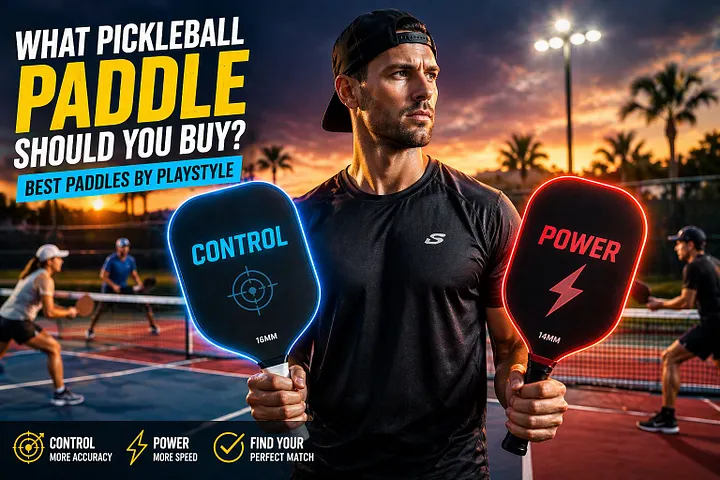
Quick Answer: What Pickleball Paddle Should You Buy?
For most players, start with a 16mm all-court paddle featuring a carbon fiber face priced between $80–$150. This combo delivers balanced control, spin, and forgiveness without breaking your budget.
- Beginners → Buy a budget paddle under $100. Your preferences will change fast.
- Control players → Choose 16mm+ thickness and a wide-body shape for maximum placement.
- Power players → Pick a 14mm elongated paddle with fiberglass or hybrid face.
Stop guessing. Here’s exactly what those specs mean for your game.
What Is a Pickleball Paddle? (Key Components Defined)
Definition: A pickleball paddle is the regulated striking implement used to hit a perforated polymer ball over a net in the sport of pickleball.
Core components defined:
- Core thickness (14mm vs 16mm): Thicker cores (16mm) provide more control and dwell time. Thinner cores (14mm) generate more pop and power.
- Face material (carbon fiber vs fiberglass vs graphite): Carbon fiber maximizes spin and control. Fiberglass adds pop and power. Graphite offers lightweight touch at entry-level prices.
- Shape categories (standard, elongated, wide-body): Standard balances reach and sweet spot. Elongated adds reach and power. Wide-body maximizes sweet spot and control.
- Weight classes (lightweight <7.5oz, midweight 7.5–8.3oz, heavyweight >8.3oz): Lighter paddles are faster at the net. Heavier paddles drive more power.
- Grip circumference: Typically 4.25” to 4.5”. Smaller grips increase wrist snap. Larger grips reduce twisting.
Regulatory context: USAPA approval is only required for sanctioned tournament play; recreational players can ignore it.
Here’s the part that confuses 90% of buyers – but it’s actually simple.
Pickleball Paddle Specs Comparison: Control vs Power vs All-Court
| Spec Category | Control Paddle | Power Paddle | All-Court Paddle |
|---|---|---|---|
| Core thickness | 16mm | 14mm | 16mm |
| Face material | Carbon fiber | Fiberglass or hybrid | Carbon fiber |
| Typical shape | Wide-body | Elongated | Standard |
| Weight range | 7.8–8.2 oz | 7.5–7.9 oz | 7.6–8.0 oz |
| Sweet spot size | Large | Small–Medium | Medium–Large |
| Pop (rebound speed) | Low (3/10) | High (8/10) | Medium (5/10) |
| Spin potential | High (9/10) | Medium–High (6–7/10) | High (8/10) |
| Best for skill level | Intermediate–Advanced | Advanced | Beginner–Intermediate |
See that “pop” column? That’s the #1 reason people buy the wrong paddle.
How Pickleball Paddle Specs Actually Affect Your Game
How Core Thickness Changes Ball Response
A 16mm core holds the ball longer on your paddle face. This extra dwell time gives you more control and feel on dinks and resets. A 14mm core releases the ball faster, creating more pop and power on drives and blocks.
How Face Material Generates Spin
Carbon fiber faces have a rough, textile-like surface that grips the ball. This friction generates high spin on slices and topspin drives. Fiberglass faces are smoother and livelier, offering less consistent spin but more pop on flat shots.
How Shape Alters Swing Weight and Reach
Elongated paddles add 0.5–1 inch in length, increasing reach and swing weight. This helps power generation but reduces hand speed. Wide-body paddles shorten the length, lowering swing weight and enlarging the sweet spot for better control. Standard shapes split the difference.
How Weight Distribution Affects Hand Speed
Handle-heavy paddles feel lighter at the face, allowing faster hand speed at the net. Face-heavy paddles shift mass forward, adding plow-through on groundstrokes but slowing reaction time. Most players prefer balanced distribution.
Still with me? Good. Now let’s talk about what each paddle type actually does for your win rate.
Performance Benefits by Paddle Type
Control Paddle Benefits
- Longer ball dwell time for pinpoint placement accuracy.
- Larger sweet spot reduces punishment on off-center hits.
- Better touch for dinking, resets, and third-shot drops.
- Predictable response even on mishits.
Power Paddle Benefits
- Faster ball speed from compact swings and blocks.
- Easier depth generation on drives and serves.
- Better put-away authority on high balls.
- Improved leverage for two-handed backhands (elongated shapes).
All-Court Paddle Benefits
- Balanced performance across every shot type.
- Most forgiving option for developing players.
- Smooth transition as your skill level improves.
- Highest versatility for mixed play (singles and doubles).
Here’s the honest truth about what each paddle costs you (in missed shots).
Pros and Cons of Each Paddle Type
Control Paddle
| Pros | Cons |
|---|---|
| Excellent placement accuracy | Requires full swing for power |
| Forgiving on off-center hits | Slower ball speed on blocks |
| Ideal for defensive playstyle | Can feel “dead” to power hitters |
| Predictable soft game touch | Less rewarding for aggressive players |
Power Paddle
| Pros | Cons |
|---|---|
| Effortless depth and speed | Smaller sweet spot |
| Great for drives and put-aways | Less forgiving on mishits |
| Rewards aggressive technique | Harder to control dinks |
| Better reach (elongated shape) | Can launch balls long |
All-Court Paddle
| Pros | Cons |
|---|---|
| Balanced performance overall | No extreme strength in any area |
| Most versatile for mixed play | May feel boring to specialists |
| Ideal for skill development | Often mid-range pricing only |
| Widest recommendation range | Jack-of-all-trades compromise |
Not sure which con would annoy you most? That’s exactly how you pick.
Control vs Power vs All-Court: Head-to-Head Comparison
When Control Paddles Win
- You play defensively or dink-heavy.
- You struggle with unforced errors going long.
- You want consistent placement over raw speed.
- Your rating is below 3.5 and you lack power technique.
When Power Paddles Win
- You play aggressively from the baseline.
- You have a tennis background with topspin strokes.
- You want put-away authority on high balls.
- You’re rated 4.0+ with solid control fundamentals.
When All-Court Paddles Win
- You’re a beginner or intermediate (2.5–3.5).
- You don’t know your playstyle yet.
- You want one paddle for singles and doubles.
- You play both defensive and offensive points.
Direct Comparison Table
| Decision Factor | Choose Control | Choose All-Court | Choose Power |
|---|---|---|---|
| Priority | Accuracy | Balance | Speed |
| Skill level | 3.0–5.0 | 2.5–4.0 | 3.5–5.0 |
| Playstyle | Defensive / Dinker | Mixed / Versatile | Aggressive / Banger |
| Typical thickness | 16mm | 16mm | 14mm |
| Typical shape | Wide-body | Standard | Elongated |
| Typical face | Carbon fiber | Carbon fiber | Fiberglass or hybrid |
Which Paddle Is Right for You? (By Skill, Playstyle, and Budget)
By Skill Level
Beginner (2.0–3.0)
- Recommendation: Budget all-court paddle under $100
- Why: Your preferences will change rapidly. Don’t overspend before you know your style.
- Specs: 16mm thickness, standard or wide-body shape, graphite or basic carbon fiber.
Intermediate (3.0–4.0)
- Recommendation: Mid-tier all-court or specialized paddle ($100–150)
- Why: Your playstyle is emerging. This is the sweet spot for value and performance.
- Specs: Carbon fiber face, 16mm for control or 14mm for power, standard shape.
Advanced (4.0+)
- Recommendation: Premium specialized paddle ($150–250+)
- Why: You need specific performance characteristics. Marginal gains matter at this level.
- Specs: Thermoformed carbon fiber, your exact thickness preference, elongated or wide-body as needed.
By Playstyle
- Dinker / Defensive player → Control paddle (16mm, wide-body)
- Banger / Aggressive player → Power paddle (14mm, elongated)
- All-court / Versatile player → All-court paddle (16mm, standard shape)
- Counter-puncher → Control paddle with some pop (15mm, hybrid face)
By Budget
| Budget | Realistic Expectation | Best Paddle Type |
|---|---|---|
| Under $80 | Entry-level, replaceable in 6 months | Basic all-court |
| $80–150 | Quality sweet spot – best value | All-court or control |
| $150–250 | Premium performance and durability | Specialized (control or power) |
| $250+ | Marginal gains for tournament players | Tournament-grade thermoformed |
By Prior Sport Background
| Background | Natural Tendency | Recommended Paddle |
|---|---|---|
| Tennis | Power, topspin, deep shots | Control paddle (tames your power) |
| Table tennis | Wrist action, quick flicks, spin | All-court paddle |
| Racquetball | Power, quick swings, angles | Control or all-court |
| No racquet sport | Undefined, developing | All-court beginner paddle |
Still reading? That means you care about not wasting money. These FAQs will save you $100+.
Pickleball Paddle FAQ: 10 Most Common Questions Answered
Q1: Is an expensive pickleball paddle worth it for beginners?
No — beginners benefit far more from skill development than equipment. A $60–100 paddle performs perfectly well for 2.0–3.0 play. Upgrade after 6–12 months when your playstyle emerges and you can actually feel the difference.
- Key detail: A $250 paddle won’t fix poor footwork or bad shot selection.
Q2: What’s the difference between 14mm and 16mm paddles?
Thickness controls how long the ball stays on your paddle face. 16mm offers more control and forgiveness (control rating 8/10). 14mm delivers more pop and power (power rating 8/10). Most players should start with 16mm.
- Key detail: 14mm paddles feel “crisp.” 16mm paddles feel “plush.”
Q3: What paddle do most professional pickleball players use?
Pros use brands like Selkirk, Joola, Paddletek, and CRBN, but their paddles are often custom or pro-tuned versions. Don’t buy based solely on pro endorsement – retail paddles differ significantly from pro stock.
- Key detail: Ben Johns uses a Joola, but his exact paddle isn’t sold to the public.
Q4: How often should I replace my pickleball paddle?
Every 6–18 months depending on play frequency. Signs of wear: loss of spin, dead spots on the face, inconsistent response, or a dull sound on contact. Heavy players (4+ times/week) replace every 6–9 months.
- Key detail: The core degrades before the face shows visible damage.
Q5: Can I add weight to my pickleball paddle?
Yes — lead tape or tungsten tape modifies swing weight and sweet spot. Common mods: add weight at 4 and 8 o’clock for stability, or at 12 o’clock for more power. Start with 0.25 oz total and test before adding more.
- Key detail: Adding weight voids warranties on some paddles. Check first.
Q6: What’s the best budget pickleball paddle under $100?
Top Reddit-recommended budget paddles include Vatic Pro Prism (often on sale), Friday Original, and XSPAK Tournament. These offer carbon fiber faces and 16mm cores for under $100 – features you used to pay $150+ for.
- Key detail: Avoid no-name Amazon paddles with fiberglass faces. They lack spin and durability.
Q7: Do I need a USAPA-approved paddle?
Only for sanctioned tournaments. For rec play, approval doesn’t matter. For league play or local tournaments, check event rules before buying. Most weekly rec games don’t check approval at all.
- Key detail: USAPA approval doesn’t guarantee quality – it only ensures legal dimensions and surface roughness.
Q8: What’s the difference between carbon fiber and fiberglass paddles?
Carbon fiber provides superior spin (8–9/10) and control due to its rough, textured surface. Fiberglass offers more pop (7–8/10) and a softer, livelier feel. Carbon fiber is preferred for advanced play. Fiberglass suits power hitters who don’t rely on spin.
- Key detail: Many “carbon fiber” paddles use a fiberglass core layer. Read full specs.
Q9: Should I use the same paddle for singles and doubles?
Yes – most players use one paddle for both. Singles favors power paddles (more court to cover, more baseline drives). Doubles favors control paddles (more dinking and resets). An all-court paddle works well for both formats.
- Key detail: If you play 80% doubles, bias toward control. If 80% singles, bias toward power.
Q10: How do I know if I need a control or power paddle?
Simple if/then test: If your shots consistently land long or high, you need more control (16mm). If opponents easily block or return your shots, you need more power (14mm). If neither is a problem, stick with all-court.
- Key detail: Most players overestimate their power needs. Start with control, then add power if needed.
Expert Verdict: The Pickleball Paddle Recommendation Framework
Summary Statement: No single best paddle exists – the right paddle matches your skill level, playstyle, and budget in that order of priority.
Tiered Recommendations
| Player Profile | Top Recommendation Type | Key Spec | Price Range |
|---|---|---|---|
| Beginner, any style | All-court budget | 16mm, standard shape, graphite face | $60–100 |
| Intermediate control player | Control carbon fiber | 16mm, wide-body, raw carbon fiber | $100–150 |
| Intermediate power player | Power hybrid | 14–15mm, elongated, fiberglass/carbon | $120–180 |
| Advanced control player | Premium control | 16mm, thermoformed, carbon fiber | $150–220 |
| Advanced power player | Premium power | 14mm, elongated, thermoformed hybrid | $150–250 |
Final Decision Rule: If you’re still unsure after reading this guide, buy a 16mm all-court carbon fiber paddle between $80–150 from a brand with a 30-day return policy. Play with it for two months. After that, you’ll know exactly what you want next – more control or more power.
Three Non-Negotiable Takeaways:
- Thickness matters more than brand name – start with 16mm unless you already know you need power.
- Budget paddles under $80 are perfectly fine for your first 6 months of play.
- Your playstyle determines your paddle – not the other way around. Don’t buy a power paddle hoping it will make you aggressive.
Key Takeaway
Most players should start with a 16mm all-court carbon fiber paddle between $80–150. Play it for two months, then decide if you need more control or more power. Don’t spend $250+ until you can clearly describe why a cheaper paddle is holding you back. Your technique matters far more than your paddle at every level below 4.5.
Comments
Post a Comment